


What Is GIS Switchgear? Working Principle, Components and Applications
Gas-insulated switchgear (GIS) is a compact medium- and high-voltage switchgear assembly whose main high-voltage components are enclosed in a sealed, gas-insulated compartment. Compared with conventional air-insulated switchgear (AIS), GIS greatly reduces the installation footprint and provides excellent environmental protection for live parts, including protection against moisture, dust and corrosion.
NATUS Electric supplies gas-insulated distribution solutions for medium-voltage distribution networks, utilities, renewable energy, industrial and transportation projects. The product range includes 40.5 kV C-GIS gas-insulated switchgear, 40.5 kV SF6 gas-insulated ring main units, and 24 kV SF6-free gas-insulated ring main units (RMUs).
This guide explains how GIS switchgear works, its main components, the differences between SF6 and SF6-free technologies, and how to select gas-insulated equipment for different distribution applications.
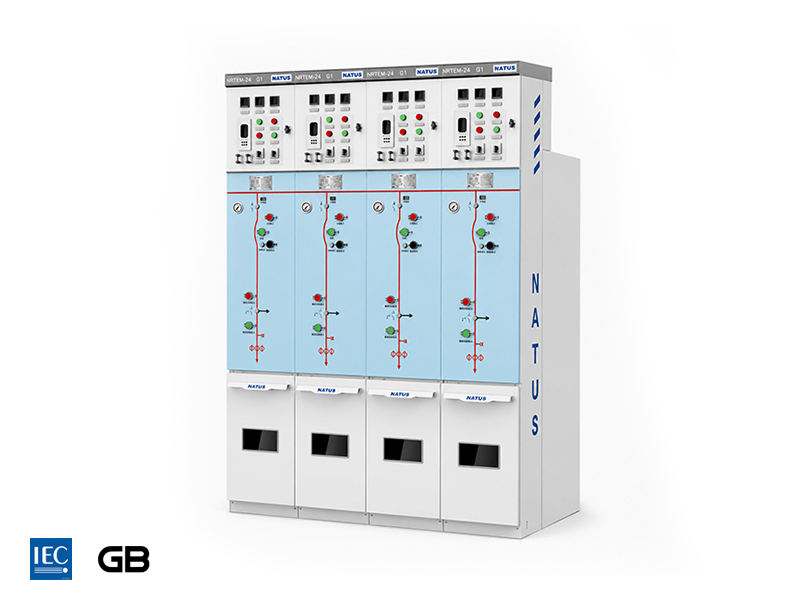
What Is GIS Switchgear?
GIS is metal-enclosed switchgear that uses an insulating gas instead of atmospheric air as the primary insulation medium for high-voltage components.
Conventional AIS air-insulated switchgear relies on air to provide electrical isolation between live parts. Because the dielectric strength of air is limited, relatively large air clearances are required.
GIS places the main high-voltage components inside a sealed gas compartment, which enables a compact structure while meeting the required insulation and switching performance.
Typical components inside a GIS gas compartment include:
Circuit breaker
Busbar
Disconnector
Earthing switch
Current transformer
Other high-voltage primary components
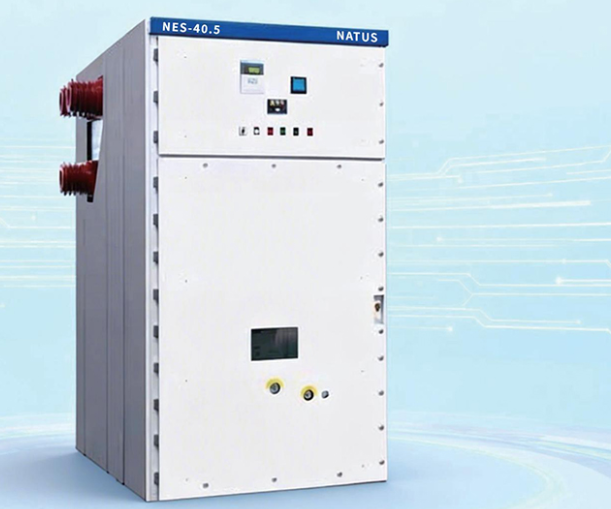
Example: NATUS NXTs-40.5 kV C-GIS integrates the high-voltage primary components in a stainless-steel gas tank and uses a three-phase common-tank structure. The gas compartment has an IP67 protection rating and an annual gas leakage rate of no more than 0.01%.
GIS Switchgear vs. AIS Switchgear
| Feature | GIS Switchgear | AIS Switchgear |
|---|---|---|
| Primary insulation medium | Insulating gas | Atmospheric air |
| Installation footprint | Compact, small footprint | Large cubicle footprint |
| Environmental protection | High protection level; less affected by the external environment | Components directly exposed to the surrounding environment |
| Installation scenario | Space-constrained or harsh-environment projects | Conventional distribution projects with sufficient space |
| Typical applications | Urban substations, underground distribution, renewable energy, industry, data centers | Conventional ground-level substations, indoor distribution rooms |
The footprint comparison assumes an equivalent primary circuit configuration.
Note: In projects with limited installation space or severe dust, salt-mist or corrosive conditions, GIS/C-GIS offers significant overall advantages.
How Does Gas-Insulated Switchgear Work?
GIS integrates switching, insulation and fault-protection functions inside a sealed metal enclosure. The complete workflow is as follows:
1. Power enters the GIS system
Medium- and high-voltage power is connected to the switchgear through cable terminations or other designated interfaces.
2. High-voltage components operate inside the sealed gas compartment
The busbar, circuit breaker, disconnector and other primary components are all enclosed in the gas-insulated compartment. The insulating gas provides dielectric insulation between live conductors and between live conductors and earth.
3. The circuit breaker interrupts fault current
When the protection system detects a short circuit or another electrical fault, it sends a trip command to the circuit breaker. The circuit breaker quickly interrupts the fault current and isolates the faulted circuit from the distribution system.
4. The disconnector provides electrical isolation
After the circuit breaker has interrupted the circuit, the disconnector provides a visible break that meets the electrical isolation requirements for maintenance and switching operations.
5. The earthing switch earths the circuit
Once the circuit has been isolated, the earthing switch reliably earths it to protect maintenance personnel.
6. Protection and monitoring systems supervise operation in real time
Modern GIS can incorporate protection relays, condition-monitoring units, communication modules and intelligent diagnostic systems.
Example: The NATUS NRTs-40.5 kV SF6 gas-insulated RMU integrates a distribution terminal unit (DTU) and provides full-lifecycle health management, including partial discharge monitoring, mechanical condition monitoring, contact temperature-rise monitoring, enclosure temperature and humidity monitoring, and video-based status recognition.
What Are the Main Components of GIS Switchgear?
The exact configuration varies with the product solution and voltage class. A complete GIS consists of the following core functional units.
1. Gas-insulated compartment
The compartment houses all high-voltage primary components. Its sealed construction keeps out external contaminants such as dust, moisture and salt mist.
Example: NATUS NXTs-40.5 uses a 304 stainless-steel gas tank with laser-welded sealing and IP67 protection.
2. Circuit breaker
The circuit breaker makes and breaks normal load current and interrupts short-circuit fault current. The required breaking capacity is determined by the calculated short-circuit level of the project.
Example: The NXTs-40.5 has a rated short-circuit breaking current of up to 31.5 kA.
3. Busbar
The busbar distributes power between incoming and outgoing circuits. In GIS, the busbar is enclosed in the gas compartment, which saves considerable space compared with AIS.
4. Disconnector
The disconnector provides a defined electrical isolation break in accordance with the operating sequence.
5. Earthing switch
The earthing switch earths the circuit after isolation to ensure safe maintenance.
6. Current transformer
Current transformers provide current signals for metering and relay protection.
7. Control and protection compartment
This is the secondary-equipment compartment and may contain:
Protection relays
Meters
Status indicators
Communication modules
Local control buttons
Online monitoring devices
The primary high-voltage gas compartment and the secondary control compartment are physically separate, so the secondary system is not affected by the high-voltage gas compartment.
What Is 24 kV GIS Switchgear?
24 kV GIS switchgear is designed for 20 kV distribution systems and has a rated maximum voltage of 24 kV. It is suitable for medium-voltage distribution applications that require a small installation footprint, high environmental protection and reliable operation.
Typical applications:
Utility distribution networks
Renewable energy projects
Industrial plants
Large commercial complexes
Urban distribution networks
Municipal infrastructure
Example: The NATUS NRTem-24 kV SF6-free gas-insulated RMU uses an environmentally friendly, SF6-free insulating medium. It has a fully sealed stainless-steel gas compartment with IP67 protection, IAC 20 kA for 1 s internal arc protection, and a rated current of 630 A.
When selecting 24 kV GIS equipment, the following key parameters must be evaluated in addition to the rated voltage:
Rated continuous current
Short-circuit withstand capability (short-time withstand current, peak withstand current and breaking current)
Internal arc classification (IAC)
Insulation technology
Gas compartment and enclosure IP rating
Site installation space constraints
Site environmental conditions (altitude, pollution, temperature and humidity)
Monitoring and communication requirements
What Is 40.5 kV GIS Switchgear?
40.5 kV GIS switchgear is used in 35 kV distribution systems and is suitable for medium-voltage distribution projects that require compact, fully enclosed, highly reliable switchgear.
Representative product: NATUS NXTs-40.5 kV C-GIS. It uses a three-phase common-tank structure, with the high-voltage components integrated in an IP67 sealed gas compartment. It is suitable for utility distribution, renewable energy collection, petrochemical, rail transit and heavy-industry projects.
Core technical specifications:
Rated voltage: 40.5 kV
Rated current: up to 3150 A depending on configuration
Rated short-circuit breaking current: 31.5 kA
Gas compartment protection: IP67
Annual gas leakage rate: no more than 0.01%
Internal arc classification: IAC AFLR, 31.5 kA for 1 s
Insulating medium: SF6 gas
Top and side busbar extension
Note: With an equivalent primary circuit configuration, this compact product can reduce the installation footprint by more than 90% compared with conventional AIS air-insulated switchgear.
What Is SF6 Gas-Insulated Switchgear?
SF6 gas-insulated switchgear uses sulfur hexafluoride (SF6) as the insulating and arc-quenching medium inside the sealed gas compartment.
Thanks to its excellent dielectric insulation performance and strong arc-quenching capability, SF6 has long been widely used in high-voltage switchgear.
Key features of sealed SF6 GIS:
Compact overall structure
Excellent dielectric insulation performance
Isolated from harsh external environments
Primary live parts are not exposed
High operating reliability
Reduced civil-engineering footprint
Example: The NATUS NRTs-40.5 kV SF6 gas-insulated ring main unit uses a sealed 304 stainless-steel gas compartment containing the busbar, circuit breaker or load-break switch, disconnector, current transformer and surge arrester. The gas compartment has IP67 protection.
Note: SF6 is a potent greenhouse gas. Global environmental regulations and low-carbon policies are driving the development and adoption of alternative insulating technologies.
What Is SF6-Free Gas-Insulated Switchgear?
SF6-free gas-insulated switchgear uses an environmentally friendly alternative insulating medium and does not use SF6 at all, eliminating the environmental impact of SF6.
This technology is increasingly used in power grids, renewable energy projects, industrial projects and other projects pursuing low-carbon power infrastructure.
Example: The NATUS NRTem-24 kV SF6-free RMU is an environmentally friendly gas-insulated ring main unit. It has a fully sealed IP67 stainless-steel gas compartment, IAC 20 kA for 1 s internal arc protection, a rated current of 630 A, and an SF6-free insulation system.
SF6 GIS vs. SF6-Free GIS
| Feature | SF6 Gas-Insulated Switchgear | SF6-Free Gas-Insulated Switchgear |
|---|---|---|
| Insulating and arc-quenching medium | Sulfur hexafluoride (SF6) | Environmentally friendly alternative insulating medium |
| Compact structure | Yes | Yes |
| Environmental profile | Established technology; SF6 is a potent greenhouse gas | Eliminates the greenhouse-gas risk of SF6; suitable for low-carbon projects |
| Typical applications | Utility grids, industry, conventional infrastructure | Renewable energy, new distribution networks, low-carbon compliance projects |
| Maintenance requirements | Depends on the product design | Depends on the insulating medium and product design |
| Selection criteria | Electrical performance, project specifications, lifecycle cost | Electrical performance, environmental regulations, project low-carbon targets |
Note: Choose the insulation technology by combining the system voltage class, electrical performance requirements, environmental regulations, site operating conditions and the project lifecycle objectives.
Key Advantages of GIS Switchgear
Compact structure
By replacing large air clearances with gas insulation, GIS greatly reduces the demand for civil-engineering space and is suitable where conventional AIS cubicles cannot be accommodated.
Typical applications:
Compact urban substations
Underground distribution rooms
Data center power supply systems
Renewable energy collection stations
Rail transit infrastructure
Industrial plant distribution
Excellent environmental protection
The sealed gas compartment isolates high-voltage components from external factors such as:
Dust
High humidity and condensation
Salt mist
Corrosive gases
Small animals
Other on-site contaminants
Example: NATUS 40.5 kV C-GIS uses an IP67 gas compartment to completely isolate the high-voltage primary parts from the external environment.
High operating reliability
The primary components are enclosed in a sealed gas compartment and are not affected by the external environment, so they maintain stable operation under harsh conditions.
Flexible installation and expansion
Modern GIS uses a modular design that supports later capacity expansion. Example: the NXTs-40.5 supports top and side extension. It is gas-filled and leak-tested at the factory, so no on-site gas filling is required for standard extension work.
Reduced maintenance workload
The sealed gas compartment keeps the primary live parts from direct exposure to on-site contamination. Depending on the product structure and operating conditions, this can effectively reduce the maintenance frequency of the primary circuit.
Note: The maintenance workload still depends on the equipment design, monitoring configuration and operating environment, and should not be understood as "maintenance-free".
Where Is GIS Switchgear Used?
GIS is widely used in medium- and high-voltage distribution projects.
1. Utility distribution networks
GIS is preferred for urban and space-constrained substations that require high equipment reliability.
2. Renewable energy
Solar power plants
Wind farms
Energy storage stations
Renewable energy collection substations
Its compact size and strong environmental protection make it very suitable for sites with limited space or harsh environmental conditions.
3. Data centers
Data centers have extremely high requirements for power supply continuity. GIS can build a highly reliable medium-voltage distribution system within a limited space.
4. Petrochemical plants
Petrochemical plants contain corrosive gases, and fully sealed GIS provides additional protection for primary components.
5. Transportation infrastructure
Metro
Railway hubs
Airports
Large transportation hubs
6. Heavy industry
Metallurgy
Cement plants
Manufacturing plants
Pulp and paper mills
NATUS 40.5 kV C-GIS is suitable for utility distribution, renewable energy, petrochemical, rail transit, heavy industry and municipal/commercial projects.
How to Choose the Right GIS Switchgear
GIS selection should start from the project electrical requirements rather than from price comparison alone.
1. Determine the rated voltage
Common voltage classes: 12 kV, 24 kV, 40.5 kV.
Note: Selection is based on the system maximum voltage, not the nominal voltage. The equipment rated maximum voltage must be greater than or equal to the system maximum operating voltage.
2. Check the rated current
The rated continuous current must cover both the current load and future expansion requirements.
3. Check short-circuit performance
Key parameters to verify:
Rated short-circuit breaking current
Short-time withstand current and duration
Peak withstand current
Internal arc classification (IAC)
These parameters directly affect personnel and equipment safety and must be greater than or equal to the calculated system fault level.
4. Evaluate the site environment
For harsh conditions, pay particular attention to:
Enclosure and gas compartment IP rating
Gas compartment sealing and leakage index
Equipment corrosion resistance
Operating temperature range
Humidity, salt mist and pollution level
Altitude (above 1000 m, external insulation requires altitude correction)
5. Select the insulation technology (SF6 / SF6-free)
For projects with low-carbon or environmental compliance requirements, evaluate SF6-free solutions first. If SF6 GIS is selected, focus on sealing and leakage performance, online gas monitoring, and full-lifecycle gas recovery and disposal.
6. Evaluate future expansion requirements
If the distribution system may be expanded, choose a GIS platform that supports modular expansion. For example, the NXTs-40.5 supports top and side extension.
7. Check standards and type tests
For international procurement, always check the applicable standards, complete type-test reports, product certificates and any project-specific compliance requirements.
Why Choose NATUS as a Gas-Insulated Switchgear Manufacturer?
When purchasing GIS for international distribution projects, supplier engineering capability is as important as product specifications.
NATUS Electric's products cover 12 kV-40.5 kV GIS and metal-clad switchgear, together with low-voltage switchgear assemblies, intelligent components, busbar systems and explosion-proof electrical products.
For GIS projects we can provide:
24 kV SF6-free gas-insulated ring main unit solutions
40.5 kV SF6 gas-insulated RMU solutions
40.5 kV C-GIS gas-insulated switchgear
IP67 sealed gas compartment designs
Proven three-phase common-tank compact technology
Modular top and side extension interfaces
IAC internal arc protection for personnel safety
Complete project technical documentation packages
Engineering selection support
Product certification and compliance documents
For overseas projects, we can provide product catalogues, certification reports, installation manuals and engineering selection support.
Note: When purchasing GIS equipment, in addition to product parameters, evaluate manufacturing capability, type-test qualifications, product certification, customization capability, engineering services and international project delivery support.
Frequently Asked Questions About GIS Switchgear
What does GIS stand for in electrical switchgear?
GIS stands for Gas-Insulated Switchgear. It is metal-enclosed switchgear that uses an insulating gas to insulate high-voltage components.
What is the difference between GIS and AIS switchgear?
GIS components are housed in a sealed gas compartment, greatly reducing the civil-engineering footprint. AIS relies on atmospheric air for insulation, requires relatively large air clearances, and has a larger cubicle footprint.
What is 24 kV GIS switchgear used for?
24 kV GIS is designed for 20 kV medium-voltage distribution systems. It is used in power grids, renewable energy, industrial, commercial and municipal projects, and is suitable where space is limited or environmental conditions are harsh and switchgear with a high protection rating is required.
What is 40.5 kV GIS switchgear?
40.5 kV GIS is gas-insulated switchgear with a rated maximum voltage of 40.5 kV. It is designed for 35 kV distribution systems and is widely used in utility distribution, renewable energy collection, industrial, rail transit and other medium- and high-voltage distribution projects.
What is SF6 gas-insulated switchgear?
It uses sulfur hexafluoride (SF6) as the insulating and arc-quenching medium inside the gas compartment. Thanks to its excellent dielectric and arc-quenching performance, it is widely used in high-voltage applications.
What is SF6-free gas-insulated switchgear?
It uses alternative insulating media and does not use SF6 gas. It is mainly used in projects with low-carbon, environmental or policy-compliance requirements.
Is GIS switchgear suitable for outdoor applications?
GIS can be used indoors or outdoors, depending on the enclosure protection, environmental rating and product design. The internal gas compartment's protection does not equal the complete unit's outdoor protection, so the outdoor suitability of the complete unit must be confirmed separately. A sealed gas compartment protects only the internal primary components.
How long does GIS switchgear last?
Equipment life depends on product design, operating conditions, maintenance strategy and component quality. During selection, confirm the manufacturer's stated mechanical life, gas leakage performance, maintenance interval and full-lifecycle test data.
Conclusion
GIS gas-insulated switchgear integrates high-voltage switching and protection components into a compact, sealed gas compartment. With its space savings, strong environmental protection and reliable operation, it is widely used in modern distribution projects such as utility substations, renewable energy stations, industrial plants, transportation infrastructure and data centers.
Conventional SF6 GIS is an established solution verified by extensive engineering practice. For projects with clear low-carbon and environmental objectives, SF6-free gas-insulated equipment can be used as an alternative.
When comparing gas-insulated products such as 24 kV GIS, 40.5 kV C-GIS and RMUs, selection should comprehensively evaluate rated voltage, rated current, short-circuit performance, internal arc protection, protection rating, insulation medium, expansion capability, applicable standards and long-term operation and maintenance requirements.
NATUS Electric's GIS portfolio includes 24 kV SF6-free gas-insulated RMUs and 40.5 kV SF6 gas-insulated RMU/C-GIS products, supported by complete technical documentation and engineering selection support for international distribution projects.
If you are looking for a gas-insulated switchgear supplier, please contact NATUS Electric for product specifications, technical documents and engineering selection support.